Exploravision
In my senior year of high school, I competed in the Toshiba-NSTA Exploravision challenge with a long-time friend, winning 1st Place Nationally out of 14,000+ participants for a speculative engineering proposal on bioremediation-based agriculture for Mars colonization.
- Spring 2023
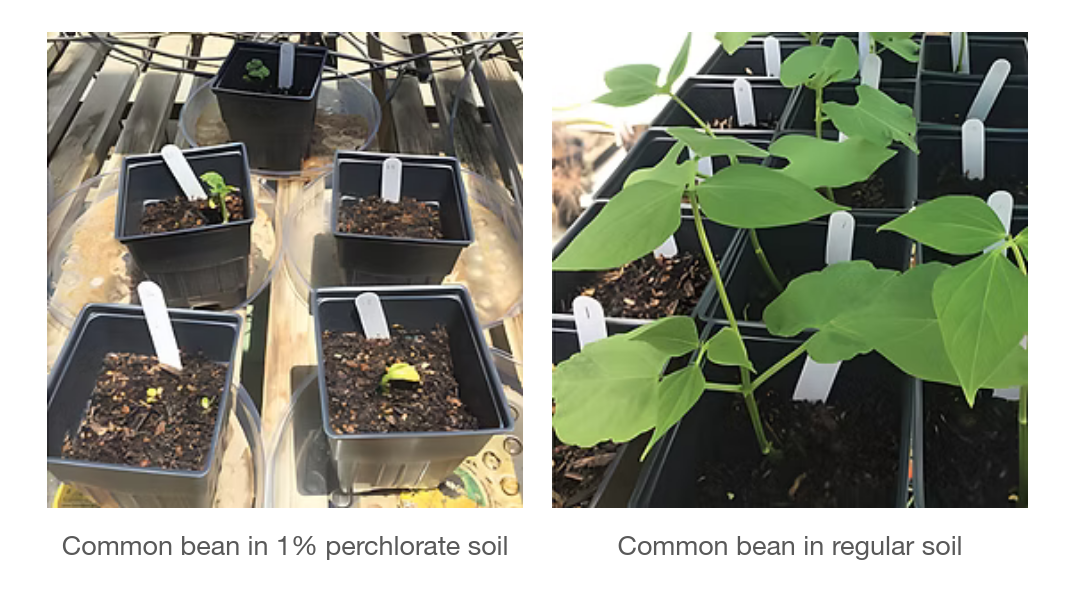
Figure 1: Comparison of the growth of common bean in regular soil and Martian regolith simulant with 1% perchlorate. Image taken from Oze et al., 2021.
Approach
The idea that eventually became our submission for Exploravision started two years earlier. My friend and I wanted to do something with bacteria in extraterrestrial environments, but we weren’t sure what yet. Our initial lack of clear vision for the project led to a not particularly successful first submission to another competition.
Reading Andy Weir’s The Martian led me to take an interest in agriculture on Mars. In designing a solution for agriculture on Mars, we researched fundamental obstacles: perchlorates in Martian regolith, which are toxic to plants and humans. In parallel, we realized that perchlorate-reducing bacteria that have evolved on Earth could detoxify the soil, but these microorganisms would need a means of survival and transport through the arid, nutrient-poor environment.
Inspired by fungal networks on Earth, we proposed using mycelial networks as a transport medium. Fungal hyphae provide a continuous liquid film, are drought-tolerant, resilient to toxic metals, and capable of forming dense networks. These networks form ideal conditions for supporting bacterial dispersal and perchlorate reduction. This would allow the system to establish a self-sustaining mechanism for detoxifying Martian soil and enabling plant growth.
Results
Several weeks after pulling a shared all-nighter to finish our paper, we were ecstatic to learn we had won regionally, and shortly after, nationally. This culminated in a trip to Washington D.C., where we met with leaders in science and science education, including Bill Nye, to discuss our work and ideas.