WiMNet
At Columbia University’s Wireless & Mobile Networking (WiMNet) Lab, I researched resilient Open RAN (O-RAN) 5G architectures to enhance communication reliability for emergency and public safety networks under disaster conditions. This research is part of an effort to integrate AI-driven control into mobile infrastructure.
- Technologies: O-RAN, Go, Python, Linux, Git, 5G Networking
- Summer 2025
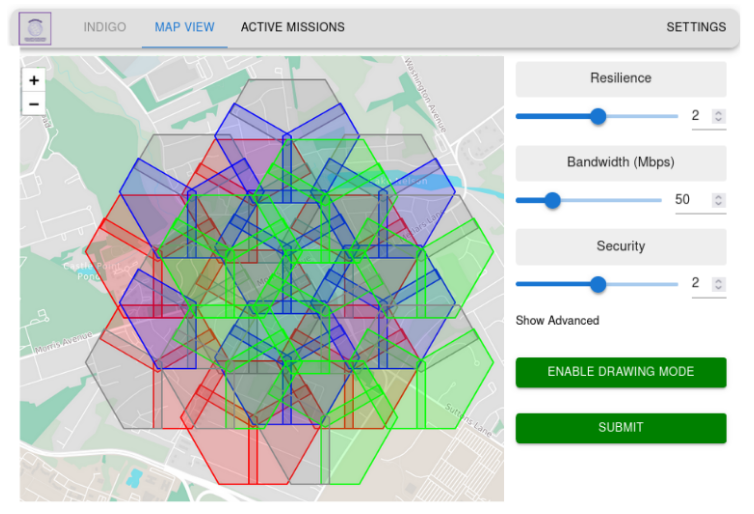
Figure 1: A screenshot of the INDIGO Mission User Interface, displaying several radio units providing coverage to an area. Gray areas are degraded, but an operator can draw a virtual slice to restore coverage by pooling resources from other operators.
Approach
As a research intern, I contributed to INDIGO, a 5G testbed designed to guarantee reliable communications for first responders during disaster scenarios. INDIGO uses a hierarchical-task network (HTN) AI planner to translate mission requirements (e.g., required bandwidth within a geographic region) into deployable network configurations for O-RAN operators.
My work focused on enhancing the interactivity and integration of the INDIGO mission user interface with the AI Planner. I designed and implemented some of INDIGO’s core user-facing components, such as the Plan Visualizer, which provided a more refined and intuitive tool for displaying the AI Planner’s generated plans. Previously, the MUI would simply display a raw Lisp-like expression that was difficult for humans to interpret. The Plan Visualizer converted this into clear blocks that explained the steps of the plan, making it easier for a human operator to interpret and validate the output. I also designed several experiments to evaluate the effectiveness of the INDIGO user interface and overall response time.
Results
This work culminated in my first academic publication: I co-authored a paper accepted to IEEE World Forum on Public Safety Technology (WFPST) 2025, describing INDIGO’s design, its performance under simulated emergency scenarios, and proposed extensions for multi-operator coordination.